
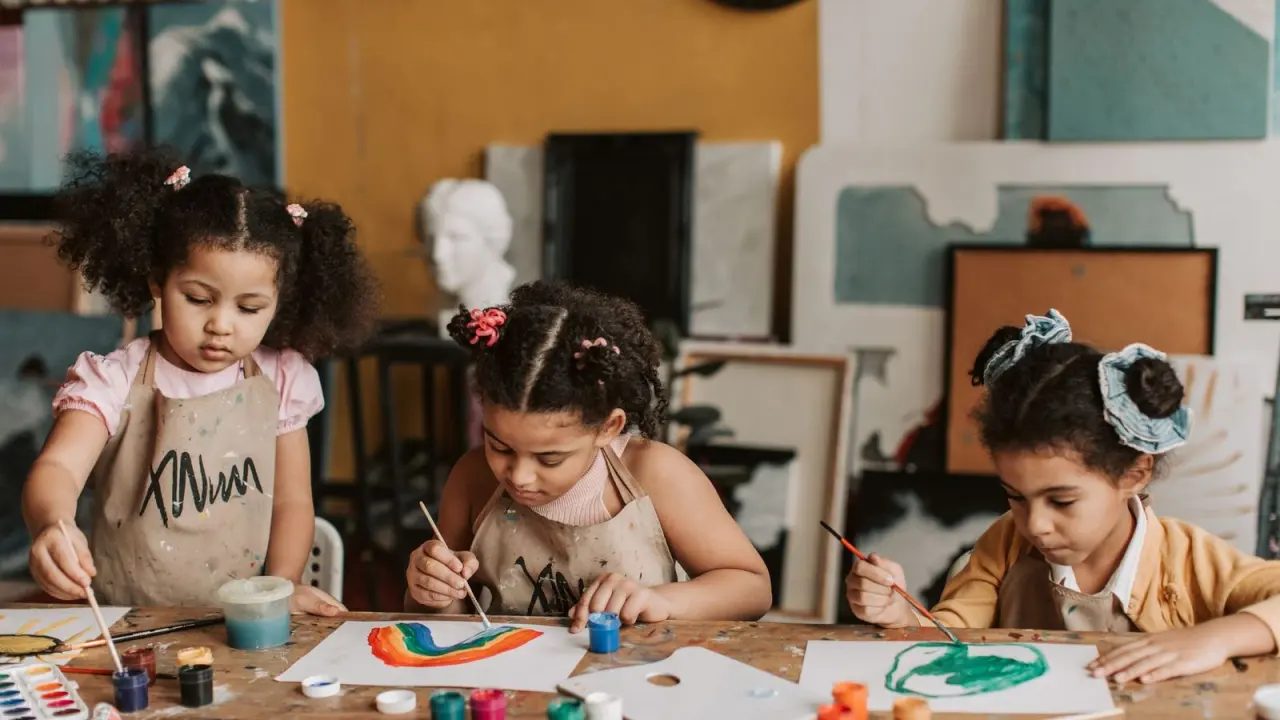
Planning afterschool arts and crafts for kids on a tight budget? Choose simple, open-ended projects, keep materials cheap, and let children make real choices. The research on school arts is encouraging but mixed, so aim for engagement first.
Crafts are one piece of a bigger picture, and the full range of afterschool activities for kids is covered in the parent guide.
| Item | Value |
|---|---|
| Schools in the Houston arts trial | 42 elementary and middle schools |
| Students in that trial | Over 10,000 third- through eighth-grade students |
| Average arts experiences per treatment-school student | 10 |
| Change in disciplinary infractions | 3.6 percentage point reduction |
| Change in standardized writing scores | 13 percent of a standard deviation improvement |
| Studies in a 2002 arts-education review | 62 studies |
The figures come from a Brookings article on the Houston trial published in February 2019 and an Education Week report from May 2002. Figures can change as new studies appear, so check the sources before you rely on them.
Why crafts earn a place in an afterschool schedule
After a day of desks and tests, children often need a task where they decide what happens next. A craft table gives them that: they choose colours, shapes and materials, and there is rarely a single right answer. That makes open-ended making a good fit for groups with a wide range of ages and abilities.
Crafts also build quiet skills that are easy to overlook. Children practise fine motor control, follow a sequence, solve small problems when glue fails, and talk with the person next to them. None of this needs expensive supplies.
What does the research on arts in school show?
The strongest recent evidence comes from Houston’s Arts Access Initiative. A Brookings write-up from February 2019 describes it as the first large-scale randomized controlled trial of a city’s collective effort to restore arts education through community partnerships. The study covered the initial two years of the program in 42 elementary and middle schools.
The 21 treatment schools were picked by lottery and received extra arts funding. They averaged $14.67 annually per student, and their students received an average of 10 arts experiences across dance, music, theater and visual arts. Compared with the control schools, the authors report:
- a 3.6 percentage point reduction in disciplinary infractions;
- an improvement of 13 percent of a standard deviation in standardized writing scores;
- an increase of 8 percent of a standard deviation in compassion for others.
Some results were limited. The authors generally did not find significant effects on math, reading or science achievement or on attendance. The trial also measured a broad mix of arts programs, including before- and after-school offerings, field trips and artist residencies, so it does not isolate craft projects alone.
An earlier Education Week report from May 2002 covered a three-year review of 62 studies. It noted that much of the research did not establish a causal link, and one reviewer cautioned against claiming the arts have been shown to cause academic improvement. The fair reading is that arts activities have promising links to engagement and social skills, while their effect on test scores remains uncertain.
Project ideas that work for mixed-age groups
The best afterschool projects have a low barrier to start and plenty of room to personalise. Here are some reliable options:
- Collage from recycled materials: cardboard, magazines, fabric scraps and bottle tops become landscapes, animals or abstract designs.
- Story-based puppets: paper bags or craft sticks, then a short performance that adds drama and speaking practice.
- Printmaking with found objects: sponges, leaves and cut vegetables dipped in washable paint.
- Clay or salt-dough models: a gentle way to build hand strength and patience.
- Group mural: one long sheet of paper that every child adds to, which suits shared themes.
- Friendship bracelets or paper weaving: repetitive patterns that calm a restless room.
Many of these travel well beyond the classroom. If your group meets in warmer months, the ideas in summer day camp activities pair naturally with a craft block, and outdoor summer learning activities offers ways to gather leaves, stones and sticks for printmaking and collage.
How to run a session from start to finish
A predictable routine keeps a craft hour calm, even with a big group. Try this simple structure:
- Prepare the tables before children arrive, with materials sorted into shared trays.
- Show a finished sample, but also show a second version that looks different, so children know they may change the plan.
- Give a short demonstration of the one tricky step, such as cutting or mixing paint.
- Let children work while you circulate, asking open questions like “What are you thinking of adding?”
- Leave time at the end for a gallery walk where children describe their own work.
- Clean up together, with each child given a small, specific job.
Invite children to talk about their work rather than judge it. This is where the social and emotional benefits are most likely to show, because they practise noticing how others feel about what they have made.
How can you keep crafts inclusive and low-cost?
Cost and access shape who gets to take part. The Brookings authors note that cuts to arts time have fallen hardest on students from historically underserved communities, which is a reason to make free or low-cost materials the default rather than the exception.
- Ask families to donate clean recyclables, and keep a “scrap shelf” anyone can use.
- Offer a range of tools so children with different motor skills can take part, such as thick brushes or pre-cut shapes.
- Avoid projects that depend on materials a child must buy at home.
- Check for allergies before using flour, food items or scented supplies.
Local libraries, museums and community groups sometimes run arts programs that partner with schools. Houston’s trial relied on that kind of partnership, and similar efforts exist in other cities, according to the Brookings authors.
Frequently asked questions
Do arts and crafts improve grades?
Show answer
The evidence is mixed. The Houston trial did not find significant effects on math, reading or science achievement, though it did report better writing scores and fewer disciplinary infractions.
What is the difference between arts and crafts in this context?
Show answer
Arts tend to emphasise self-expression, while crafts emphasise making something with a technique. In practice the two overlap, and most afterschool projects blend both.
How much should a craft project cost?
Show answer
It can cost very little. Recycled materials, scraps and basic paint cover most of the ideas above, so a budget is more about storage and sorting than purchases.
Should every child make the same thing?
Show answer
Not usually. Open-ended prompts let children of different ages and skill levels succeed, and they leave room for personal choice, which is what makes the activity engaging.